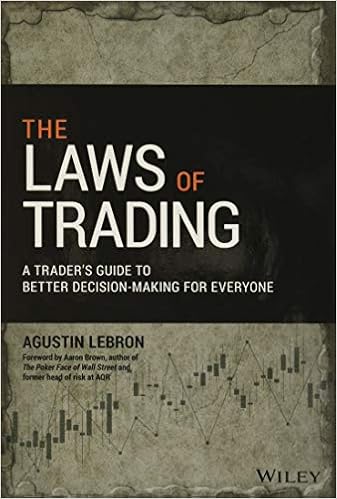
<aside> 💡 My Introduction
If I ran a trading firm this would be Day 1 reading. After finding out where the bathroom is and filling out your W-4, you would be handed this book and told to finish it by tomorrow.
After 1 year on the job, you are required to re-read it. There are many sentences in this book that serve as somewhat off-hand or connecting, but are deeply insightful. The kinds of things that would not be perceived by a novice but veterans will recognize they are reading something by a deeply experienced professional. As a veteran of options trading, I found this feature makes the book transcend being informative into being delightful.
Trading is the art of decision-making turned into a high-rep game. It requires:
It is deeply intertwined with technology, math, and economic reasoning.
This book is an instant classic. The rules in the book are reductions of vast, hard-fought institutional knowledge and the leading edge of thinking about risk.
The author combined his training and experience at Jane Street, a legendary quant trader and market-making firm, with a broad intellectual acumen. Both his engineering background and affinity for liberal arts and philosophy come through to create a guide that transcends a single discipline.
Personally, reading this book left me with nostalgia as the type of thinking was the water I swam in when I was at SIG (Jane Street’s lineage traces to SIG alumni who became under-the-radar legends themselves). My second personal feeling is, “damn, I wish I wrote that book.” Except I couldn’t. The author is an elite synthesizer with a nuanced comprehension for coding, organizational behavior, interviewing, and data analysis.
My notes are below. They are sparse compared to the depth of insight crammed into 250 pages. Every chapter covers a “rule”, situates that rule in the context of finance, then applies it to decisions all people face in the course of life.
</aside>
Chapter 1: Motivation
Chapter 2: Adverse selection
Chapter 3: Risk
Chapter 4: Liquidity
Chapter 5: Edge
Chapter 6: Models
Chapter 7: Costs and Capacity
Chapter 8: Possibility